In today’s complex threat landscape, maintaining a full-scale, in-house Security Operations Center (SOC) is a significant challenge for many organizations. The expertise, technology, and 24/7 staffing required are prohibitively expensive and difficult to sustain. This is where SOC-as-a-Service (SOCaaS) emerges as a powerful and strategic solution, offering enterprise-grade security monitoring and response without the massive overhead.
SOC-as-a-Service is a subscription-based model where a third-party provider delivers comprehensive security monitoring, threat detection, and incident response functions. It combines cutting-edge technology—like SIEM (Security Information and Event Management), EDR (Endpoint Detection and Response), and threat intelligence platforms—with a team of expert security analysts who work around the clock to protect your digital assets.
Managed SOC Services: What’s Under the Hood?
A typical SOC-as-a-Service offering is a multi-layered solution designed to act as an extension of your IT team. Core components usually include:
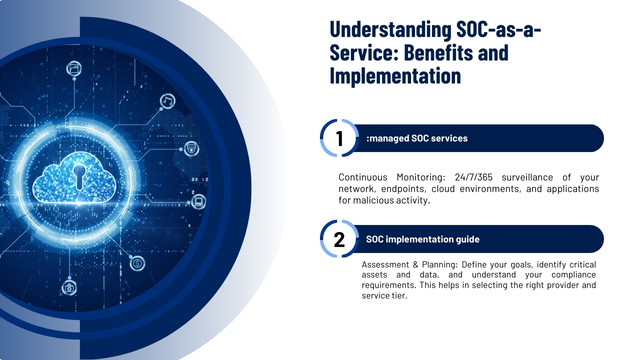
· Continuous Monitoring: 24/7/365 surveillance of your network, endpoints, cloud environments, and applications for malicious activity.
· Threat Detection: Advanced analytics, machine learning, and threat intelligence are used to identify known and unknown threats, moving beyond simple signature-based detection.
· Incident Response: When a threat is confirmed, the SOC team springs into action to contain and eradicate the threat, providing clear guidance and support throughout the process.
· Log Management & SIEM: Centralized collection and analysis of security-relevant data from across your entire technology stack.
· Compliance Reporting: Help with meeting regulatory requirements (like PCI DSS, HIPAA, GDPR) through detailed reports and audit trails.
Benefits of SOC-as-a-Service
Adopting a SOCaaS model delivers a compelling array of advantages over building an in-house SOC:
· Cost Efficiency: Eliminates the multi-million-dollar investment in security infrastructure, software licenses, and hiring a full team of highly specialized analysts. You convert large capital expenditures into predictable operational expenses.
· Access to Expertise: You gain immediate access to a diverse team of seasoned security professionals, including threat hunters, incident responders, and forensic analysts, without the recruiting and retention headaches.
· Advanced Technology: SOCaaS providers invest heavily in the latest security tools and threat intelligence feeds, ensuring you are protected by state-of-the-art technology that is constantly updated.
· Scalability: The service can easily scale up or down to match your organization’s growth and evolving security needs, whether you’re adding new users, applications, or entire cloud environments.
· 24/7 Coverage: Cyber threats don’t keep business hours. SOCaaS provides continuous, always-on monitoring and response, ensuring you are protected day and night, including weekends and holidays.
SOC Implementation Guide: Getting Started
Implementing a SOC-as-a-Service solution is a strategic process designed for minimal disruption.
1. Assessment & Planning: Define your goals, identify critical assets and data, and understand your compliance requirements. This helps in selecting the right provider and service tier.
2. Provider Selection: Choose a provider that aligns with your industry, technology stack, and specific security needs. Evaluate their technology, expertise, and response playbooks.
3. Onboarding & Integration: The provider will work with your team to deploy necessary sensors and agents (e.g., on endpoints, servers, network devices) and integrate them with your existing systems to begin forwarding logs and telemetry data to their cloud-based platform.
4. Tuning & Customization: The SOC team will fine-tune detection rules to reduce false positives and ensure alerts are relevant to your unique environment. This phase is critical for efficiency.
5. Go-Live & Operation: The service transitions into full operational mode, with continuous monitoring and management. You will receive regular reports and have a clear channel for communication and escalation.
Frequently Asked Questions (FAQ)
Q: How is SOC-as-a-Service different from Managed Detection and Response (MDR)?
A: The terms are often used interchangeably. Generally, MDR is a core component of a broader SOCaaS offering. SOCaaS typically includes a wider set of services like log management, compliance reporting, and vulnerability management, while MDR focuses specifically on threat detection and response.
Q: Is my data safe with a third-party SOC provider?
A: Reputable providers prioritize data security. They employ robust encryption for data in transit and at rest, operate in secure, compliant data centers, and adhere to strict access controls and confidentiality agreements. Always review their security practices before signing.
Q: Can SOC-as-a-Service help with compliance?
A: Absolutely. A key benefit of SOCaaS is its ability to generate the detailed audit trails, security event logs, and compliance reports required by regulations such as PCI DSS, HIPAA, SOX, and GDPR.
Q: What happens when the SOC detects a real threat?
A: Their dedicated team will follow predefined playbooks to investigate the alert. Upon confirmation, they will immediately alert your designated contacts, provide a detailed analysis of the threat, and work with your team to contain and eradicate it, guiding you through the entire response process.
