
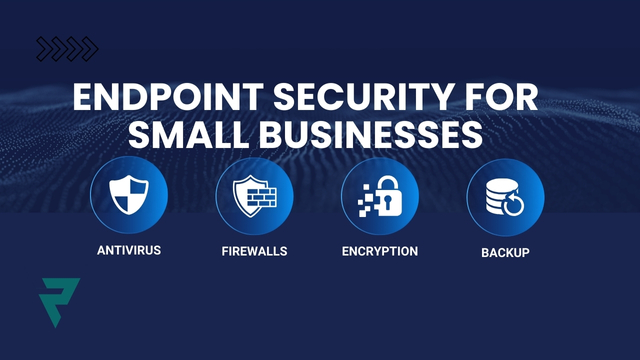
The Growing Threat Landscape for Small Businesses
In today’s digital economy, small businesses face an ever-expanding array of cyber threats. Many operate under the false assumption that their size makes them invisible to cybercriminals, when in reality, their often-limited security resources make them attractive targets.
Endpoint security refers to the practice of securing endpoints—such as desktops, laptops, mobile devices, and servers—from cyber threats. These entry points are vulnerable to attacks that can compromise your entire network.
What Exactly Are Endpoints?
Endpoints are any devices that connect to your central network from outside its firewall. For small businesses, these typically include:
Common Endpoints in Small Business Environments
- Employee laptops and desktop computers
- Smartphones and tablets (both company-owned and BYOD)
- Point-of-sale (POS) systems
- Printers and other network-connected devices
- Servers and network storage devices
Why Endpoint Security is Crucial for Small Businesses
Small businesses often underestimate their risk profile, but consider these sobering statistics:
| Risk Factor | Impact on Small Businesses | Prevention Strategy |
|---|---|---|
| Phishing Attacks | 58% of breach victims are small businesses | Employee training + endpoint protection |
| Ransomware | Average ransom demand of $200,000+ | Regular backups + advanced endpoint security |
| Data Breaches | Average cost of $3.9 million per incident | Encryption + access controls |
| Insider Threats | 34% of attacks involve internal actors | Monitoring + least privilege access |
Building an Effective Endpoint Security Strategy
Implementing robust endpoint security doesn’t have to be complex or prohibitively expensive. Here’s a layered approach that works for small businesses:
Essential Endpoint Security Layers
- Antivirus and Anti-malware: Foundation protection against known threats
- Endpoint Detection and Response (EDR): Advanced monitoring and threat hunting
- Firewall Protection: Network traffic monitoring and filtering
- Application Control: Restricting unauthorized software execution
- Device Encryption: Protecting data if devices are lost or stolen
- Patch Management: Regular updates to fix security vulnerabilities
FAQ: Endpoint Security for Small Businesses
Traditional antivirus software primarily focuses on detecting and removing known malware signatures. Endpoint security provides a more comprehensive approach that includes antivirus protection but adds features like behavioral analysis, firewall management, device control, and intrusion prevention. It offers proactive protection rather than just reactive scanning.
Costs vary based on features and number of endpoints, but many solutions designed for small businesses range from $5 to $15 per endpoint per month. Some providers offer discounts for annual subscriptions. While there’s an investment involved, it’s minimal compared to the potential costs of a security breach.
Yes, modern endpoint security solutions are specifically designed to protect devices regardless of their location. Cloud-based management consoles allow IT administrators to monitor, update, and secure endpoints across geographically dispersed locations, making them ideal for businesses with remote workers.
Key features to consider include: centralized management console, real-time monitoring, behavioral analysis, compatibility with your systems, ease of use, quality of technical support, and scalability. Many providers offer free trials so you can evaluate solutions before committing.
